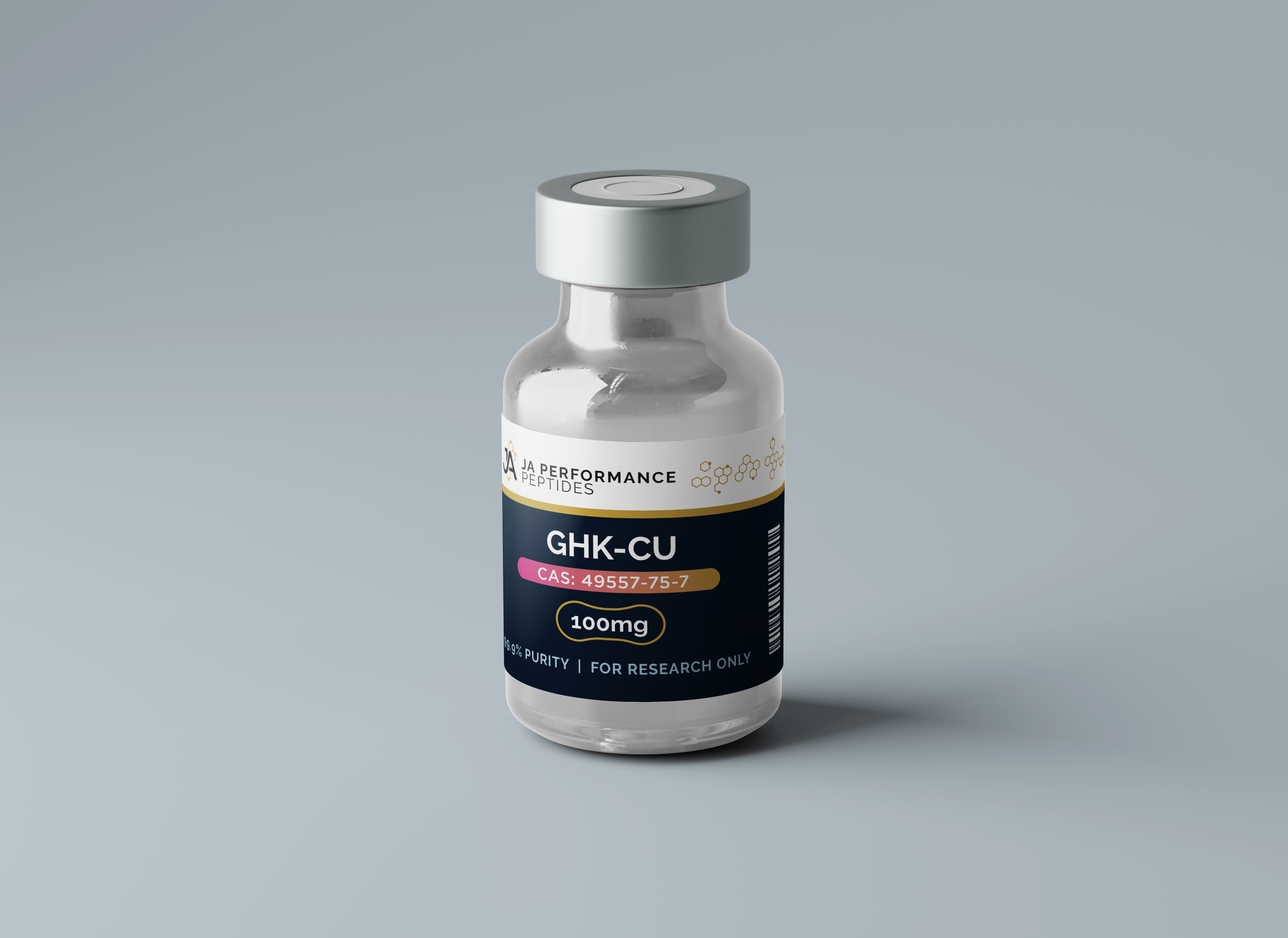
GHK-Cu Dosage Guide: Injection Protocol, Reconstitution & Cycle Length
A complete GHK-Cu peptide injection dosage reference — reconstitution math, dosing charts for 50 mg and 100 mg vials, dosing frequency, cycle length, and storage, all in one place.
GHK-Cu peptide injection dosage comes down to three numbers: how concentrated your reconstituted solution is, how many milligrams you're aiming for per injection, and how many units that translates to on a syringe. This guide walks through that math for both the 50 mg and 100 mg vial sizes, plus the dosing frequency, cycle length, and storage details that go with it.
For the interactive version of these numbers, use the GHK-Cu dose calculator or see the full GHK-Cu dosage protocol for both vial sizes side by side. For the underlying research on what GHK-Cu does and why it's studied, see GHK-Cu: The Copper Peptide Rewriting the Science of Skin & Longevity.
Quick Reference
- ·Vial sizes: 50 mg or 100 mg lyophilized powder
- ·Reconstitution: 3.0 mL sterile or bacteriostatic water for both vial sizes
- ·Concentration: ~16.67 mg/mL (50 mg vial) or ~33.3 mg/mL (100 mg vial)
- ·Route: Subcutaneous injection
- ·Dose range: 1.0–2.0 mg per injection, typically titrated upward
- ·Frequency: 5 days/week, or 2 mg 3x/week for the 50 mg vial
- ·Cycle length: 8–16 weeks depending on vial size and schedule
- ·Storage: −20 °C lyophilized; 2–8 °C reconstituted, use within 30 days
How to Calculate GHK-Cu Injection Dosage
Reconstituting a 50 mg or 100 mg vial with 3.0 mL of bacteriostatic water gives a fixed concentration, and every dose is just a fraction of that:
Concentration (mg/mL) = Vial size (mg) ÷ Reconstitution volume (mL)
50 mg ÷ 3.0 mL  = ~16.67 mg/mL
100 mg ÷ 3.0 mL = ~33.3 mg/mL

Units on a U-100 syringe = (Desired dose in mg ÷ Concentration in mg/mL) × 100
On a standard U-100 insulin syringe, 1 unit = 0.01 mL. So for the 50 mg vial at 16.67 mg/mL, a 1.0 mg dose is 0.06 mL, or 6 units. For the 100 mg vial at 33.3 mg/mL, that same 1.0 mg dose is only 0.03 mL, or 3 units — half the injection volume, because the solution is twice as concentrated. This is the most common source of dosing confusion between the two vial sizes: the milligram dose can be identical while the unit count is completely different.
For volumes at or below 0.10 mL, a 30- or 50-unit insulin syringe (rather than the standard 100-unit) makes the markings easier to read accurately.
GHK-Cu Dosage Chart: 50 mg Vial
At ~16.67 mg/mL (3.0 mL reconstitution):
- ·Weeks 1–4: 1.0 mg (1000 mcg) — 6 units — 0.06 mL
- ·Weeks 5–8: 1.5 mg (1500 mcg) — 9 units — 0.09 mL
- ·Weeks 9–12+: 2.0 mg (2000 mcg) — 12 units — 0.12 mL
A single 50 mg vial covers roughly 8 weeks of daily (5x/week) dosing at this titration.
GHK-Cu Dosage Chart: 100 mg Vial
At ~33.3 mg/mL (3.0 mL reconstitution):
- ·Weeks 1–4: 1.0 mg — 3 units — 0.03 mL
- ·Weeks 5–8: 1.5 mg — 4.5 units — 0.045 mL
- ·Weeks 9–12: 2.0 mg — 6 units — 0.06 mL
Because the 100 mg vial holds twice the peptide in the same 3.0 mL volume, one vial covers roughly 8–12 weeks of daily dosing — about double the mileage of the 50 mg vial at the same dose schedule.
How Often Should You Dose GHK-Cu?
Two dosing patterns show up most often in GHK-Cu research protocols:
- ·Daily (5 days/week): Inject once daily, Monday–Friday, with weekends off. Dose titrates gradually from 1.0 mg up to 2.0 mg over 4–8 weeks. This is the standard schedule for both vial sizes.
- ·3x/week (50 mg vial only): Inject 2 mg on Monday, Wednesday, and Friday — roughly the same weekly total (6 mg/week) as the daily schedule, delivered in fewer injections.
Both patterns are titration-based rather than a fixed dose from day one — starting low and increasing every few weeks is the more commonly studied approach than jumping straight to 2.0 mg.
Cycle Length and Structure
- ·Typical cycle: 8–12 weeks, sometimes extended to 16 weeks
- ·Effects are cumulative and are generally reported as becoming noticeable around 4–6 weeks into a cycle, not immediately
- ·A break of 2–4 weeks between cycles is a common structure before repeating
Injection Technique
- ·Rotate injection sites — abdomen (at least 1 inch from the navel), outer thighs, and upper arms are the standard rotation
- ·Clean the injection site with an alcohol swab and let it air-dry fully before injecting
- ·Inject slowly and steadily, and withdraw the needle at the same angle it went in
- ·Log the dose, date, and injection site each time — this matters more than it sounds like it would, especially once the dose starts changing week to week
Storage and Handling
- ·Lyophilized (before mixing): −20 °C or lower, dry and dark
- ·Reconstituted: Refrigerate at 2–8 °C, protected from light, and use within 30 days
- ·Let a refrigerated vial come to room temperature before drawing from it — this reduces condensation inside the vial
- ·A faint blue tint after reconstitution is normal for GHK-Cu and indicates the copper complex is intact, not a sign of a problem
See the peptide storage guide for how this compares across other research compounds.
Common GHK-Cu Dosing Questions
How much GHK-Cu should I inject daily? Most protocols start at 1.0 mg (6 units for the 50 mg vial, 3 units for the 100 mg vial) and titrate up to 2.0 mg over 4–8 weeks, rather than starting at the top of the range.
Is 1 mg or 2 mg the right GHK-Cu dose? Both appear in the dosing chart above — 1.0 mg is the typical starting point, 2.0 mg the typical ceiling after titration. The full range (1.0–2.0 mg per injection) reflects a gradual increase, not two competing protocols.
Does GHK-Cu dosage differ between the 50 mg and 100 mg vial? The milligram dose range is the same either way (1.0–2.0 mg). What changes is the unit count on the syringe, because the 100 mg vial is reconstituted to roughly double the concentration of the 50 mg vial in the same 3.0 mL of water.
How many units of GHK-Cu should I draw? 6–12 units for the 50 mg vial, 3–6 units for the 100 mg vial, corresponding to the 1.0–2.0 mg dose range — see the charts above for the week-by-week breakdown.
Can GHK-Cu be dosed less than 5 days a week? Yes — the 3x/week schedule (2 mg on Monday/Wednesday/Friday) is a documented alternative for the 50 mg vial that reaches a similar weekly total with fewer injections.
Shop GHK-Cu in 50 mg and 100 mg vials, or use the GHK-Cu dosage protocol page for an interactive version of the schedule above.
This guide is for educational and research purposes only and is not medical advice. GHK-Cu is sold strictly for laboratory research use — not for human consumption.